Demo image Demo image Demo image Demo image Demo image Demo image Demo image Demo image

AdHitz

Amazing Biography of Chen Li

  • Tuesday, December 6, 2011
  • Лексу
  • Amazing Biography of Chen Li 

    Chen Li - born 1971

    Chen Li I
    Chinese Prints
    Chinese Prints
    Vase, 2007
    copyright Chen Li
    Chen Li is the son of famous Yunnan artist Chen Yongle. But his style is different from his father's. Chen Li tries to combine the style of traditional Chinese brush painting, the typical colorful Yunnan look and elements from Western abstract painting. The result are pleasing, colorful woodblock prints - Chen Li style.
    The images on this page are link-sensitive and take you to other articles or web sites in which you might be interested.

    Chen Li - Education

    Mr.Chen Li was born in 1971 in Kunming city, the capital of Yunnan province. Being the son of the famous Yunnan painter Chen Yongle, he was influenced by painting and printmaking from his childhood on.
    But Chen Li was not satisfied with the traditional style of Yunnan painting. Therefore he went his own way trying to combine the warm colors and fluent lines of Yunnan paintings with a more abstract style. Chen Li combines the style of Yunnan Art School with elements of traditional Chinese brush painting and abstract Western painting.

    Exhibition and Awards

    Chen Li II
    Chen Yongle - Biography
    Chen Yongle - Biography
    Bird of Paradise, 2007
    copyright Chen Li
    • 1998 - "Fragrance, Autumn's Spring" was selected for the 14th National Print Exhibition of China.
    • 2000 - "Moon on the Cold Mountain" was selected for the 15th National Print Exhibition of China.
    • 2001 - "Dancer" was selected for the art exhibition for the celebration of the 52nd anniversary of the foundation of the People's Republic of China.
    • 2002 - "Praise Song" won the copper prize of the Yunnan art exhibition "Prize of Colors".
    • 2003 - The oil painting series "Landscape" was selected for the third Chinese Oil Paintings Exhibition, Yunnan province.
    • 2004 - The woodcut print "Songs of Yunling Echo the Mountain" was selected for the 10th National Art Exhibition and won the second prize of the art exhibition for the Celebration of the 55th anniversary of the foundation of the people's republic of China.
    • 2004 - The woodcut print series "Colorful House" was selected for the 10th National Art Exhibition and won the second prize of Yunnan Art Exhibition.
    • 2005 - "Silenct Mountain" was selected for the Taipei Contemporary Artists Invited Exhibition.

    Chen Li - Gallery

    Here are a few more of Chen Li's beautiful woodblock prints.
    Dieter Wanczura
    (December 2009)
    Chen Li III
    Chinese Prints - Info
    Chinese Prints - Info
    Autumn of Westlake, 2007
    copyright Chen Li
    Chen Li IV
    Chinese Prints - Article
    Chinese Prints - Article
    Colorful House No.1, 2001
    copyright Chen Li
    Chen Li V
    Chinese Prints - Introduction
    Chinese Prints - Introduction
    Colorful House No.2, 2001
    copyright Chen Li


    Copyright ©2001-2011 artelino GmbH. All rights reserved. 

    Full History of The Abstract Art - Abstract Expressionism Movement and Expressions

  • Saturday, November 26, 2011
  • Лексу

  • Full History of The Abstract Art - Abstract Expressionism Movement and Expressions 


    The Abstract Expressionism Movement, also called the New York School was exclusively an American abstract art movement that mainstreamed in New York City in the period following the Second World War. This movement was significant in the sense that it was the earliest American movement to declare non-dependence on European styles and to get a sway all over the globe. It also enabled New York City to replace Paris as the art hub. Prior to its reference to American art, “abstract expressionism” was a term used in the Berlin periodical named ‘Der Sturm’, in 1919. 


    Arshile Gorky played an important role in inducing The Abstract Expressionism Movement. The abstract art works produced during the period of this movement are considered to be a combination of certain visual aspects of abstract European schools like Futurism, Synthetic Cubism and Bauhaus with the self-expression and emotional strength of German Expressionism. Though this abstract art was a mixture of a number of styles, its basic philosophy was to search and seek out answers for questions relating to human existence. 


    There are many similarities of style between abstract expressionism art and the work of Russian artists of the early 1900’s, the most prominent being Wassily Kandinsky. The abstract art from this period of the movement is often characterised by giving the impression of being produced in an act of artistic spontaneity. The work of pioneers of the movement such as Kandinsky, Kunz and later Rothko dealt with the expression of subjects including spirituality and the subconscious. However, meticulous planning and conscious thought was often involved in creating the many of the well known works of art which define this period of the expressionist movement.


    In the 1930’s in North America, prior to the mainstream acceptance of abstract art, social realism art had been the prominent genre of art. Mexican social realists such as Diego Rivera and David Alfaro Siqueiros together with the Great Depression strongly influenced the acceptance and widespread popularity of this relatively short lived movement. Preceding the Second World War in the United States there arose a time of political sensitivity. Due this change in the political climate social protest made through art would no longer be tolerated. In American society an artistic vacuum had opened and the abstract expressionism movement arose into the mainstream, showcasing at major galleries in New York such as The Art of This Century Gallery. The abstract expressionist movement spread rapidly thorough the elite art community of the United States through its major artistic communities such including the San Francisco Bay area and California.


    During the period of The Abstract Expressionism Movement, several artists started experimenting with shapes and colour. They broke away from what was considered to be artistic, conventional painting and painted complete canvases in blue, orange or other colours. Dripping, splattering and big brush strokes were characteristic features of Abstract Expressionist Art. The artists of this period preferred larger canvases positioned on the floor over canvases that were easel bound and moderate. The focus of abstract art within the expressionism movement was not the portrayal of objects but the portrayal of emotions. 


    In the broad sense, Abstract Expressionism was of two streams – Colour Field Painting and Action Painting. Colour field painting came up in the beginning of the 1960’s and involved using shape and colour to create religious serene paintings that were devoid of representative subject substance. The composition of colour field works were huge coloured areas with no forms or signs. Helen Frankenthaler, Mark Rothko and Ellsworth Kelly were some painters associated with this type of painting. Action Painting was a painting stream that arose prior to Colour Field Painting (between the 1940s and 1950s) and practiced by artists such as Jackson Pollock, Willem de Kooning and Franz Kline. The driving force for the works of these painters was often considered to be the painters’ soul and life energy.


    Abstract Expressionist Art appeared to be defiant, idiosyncratic and radical, and to some, nihilistic. The movement weakened in the 1960s while other movements such as minimalism and pop art arose in opposition to it. Despite the movement losing importance, a good number of abstract expressionist painters continued following its characteristic painting fashion for many more years. In addition, this art movement profoundly influenced how some American artists of later generations used materials and colour in their Abstract Art.
    Source

    Article Author:
    Innes Desborough


    High quality and affordable artists blank canvases can be purchased form www.artistsblankcanvas.co.uk
    www.artistsstretchedcanvas.co.uk and www.artists-canvas.co.uk.


    Today's 3D Animations Are Not Only For Movies

  • Monday, November 14, 2011
  • Лексу
  • Today's 3D Animations Are Not Only For Movies   


    Talent relating to the creation of animation is a wonderful gift. The creators of animation love it just as much as the people that watch it. In the past, the most creative pieces were constructed via 2D animation, although now, the revolution of 3D technology has meant that this is both better quality and easier to produce. 3D offers both the realism of real life, contrasting with the technologically advanced implementation of computing technology, making it spectacular for the viewers.


    All animation starts with a foundation or base, just like a builder would lay foundations for a house. This allows the animators to develop and build on ideas or concepts that they have produced so far. Once they are happy with the ideas that have been developed, animators can focus on using 3D rendering processes to enable their animations to ‘come to life’. The rendering techniques that animators use make a huge difference; they make something good into something amazing.


    3D Flash and online 3D illustration have come such a long way over the last 5-6 years or so. Before this time, software resources were available, but at a cost. This meant that if animators wanted to produce a piece then they’d be looking at a huge investment to get software up and running. These days software is cheaper, as well as a lot more capable, which opens many doors for new and experienced animators.


    The common misconception is that animation is just something that is used in cartoons, or kids programs. This is simply not true. Anything that has been manipulated via computer technology is classed as animation. This might be building plans made into 3D or even a virtual car design. Animators work in hundreds of industries, not just cartoons!


    Where as cartoons were where the 3D animation really took off, there is a new use for it. Businesses throughout the world are showing their professionalism and dominance in their industry by producing ranges of ‘flash’ products or services, making them look special via 3D animation. A typical example these days would be both offline and online marketing companies. These companies use as much outside help to make their company, products or even services look that little bit better. Of course, 3D animation and rendering techniques are exactly what they should be implementing if this is what they want to achieve. Next time you take a look at a marketing company, or even any company trying to sell products, see if their website or brochure catches your eye, and if so, is it because they are implementing 3D animation? Using animation rendering techniques is a way for them not only to make their company look better, but to stand out from the crowd.


    Where are 3D animation rendering techniques found elsewhere?


    Are you a teacher, or have you been taught? It’s a well known fact that there are a range of ways people take on board new information. The vast majority of students (the topic is irrelevant) respond really well to visual resources such as books, pictures or even computer based visual resources. The internet and computers are so popular these days, that there isn’t actually the need for a teacher. Instead interesting, exciting and educational courses can be put together for use via a computer and then made to be kind to the eye by implementing 3D animation rendering techniques.


    Where is the future of 3D animation going?


    Like any industry, it is moving extremely fast. A rendering technique used today, might be absolutely useless tomorrow. Software is the key ingredient to producing quality 3D animation. Anyone looking to get into the industry, or already involved will need to have a keen eye for what’s hot and what not, other wise they are likely to be left in the dust. That being said, animation software doesn’t do the work for you, the end product will only be as good as the person behind the computer screen implementing rendering techniques.


    To begin with 3D animation was basically operating software. Now, because of the technologically advanced features and processes that can be implemented, it goes much further than that. The more creative and artistic the operator of the software is, the bigger the chance that the end product is going to be something of a masterpiece. The combination of great creativity, experience in the arts industry and the knowledge to operate powerful 3D animation software, using the correct rendering techniques, can create extremely powerful animations.


    Article Author:
    Benicio Brown


    Article courtesy of http://www.rebusmedia.net/ , 3D animation services including rendering, animation production, 3D design, 3D video, and more.


    Source 
    http://www.freearticledirectory.co.uk/article89526.html


    Copyright © 2007 - 2008 Free Article Directory


    Expression of Western Artist - Japan

  • Saturday, November 5, 2011
  • Лексу
  • Expression of Western Artist - Japan 

    Sankeien Gardens

    copyright Paul Binnie
    March 2005: Paul Binnie announced his latest design 'Sankeien' from the series of 'Famous Views of Japan'.
    Here is the original text of the announcement by Paul Binnie:

    The First Lunar Month, 1993

    The Sankeien Gardens in the Snow, Yokohama

    As you may know, I have been working on a series of landscape woodblock prints called 'Nihon Meisho Zu-e' or Famous Views of Japan, of which three have been released already; Aka FujiMiyajima No Torii and Himeji Castle. I have now completed the fourth in the series, Sankeien, which is a view of the famous Sankeien Gardens in Yokohama in the snow.
    I visited the garden in April of 2004, and of course it was cherry blossom time, which was extremely beautiful, but unfortunately Yoshida Hiroshi did a view of these very gardens with cherry blossom (Abe 191), so I decided to use some artistic license and make it a snow scene, in shades of blue, lilac and grey-green, which tones well with the horizonal image of Himeji Castle, also in blues: in fact, these two were conceived as a pendant to one-another.
    I have used gofun printed over the entire lower area to make a very snowy white, rather than keep the paper blank as many printmakers do, and I also have used mica to highlight the ice on the frozen edge of the lake, which gives a silver sheen to the surface. One thing which you may not be able to see in the attached scan, but which adds greatly to the effect of the print, is a line of embossed footprints, walking past the lake edge, seemingly compressing the snow underfoot. If the print is handled, or hung on a wall, these appear in subtle shadow, and add an extra dimension to the design. As always in this series, there is also the blind-printed 'Binnie' in the bottom margin, and the format is identical to Himeji Castle: Dai-Oban Yoko-e, 29.5 x 40.5cm  (11 1/2 x 16 inches). The edition is as usual 100, and the price is the same as all the other Dai-Oban prints.
    As always, I hope to hear reactions to the new designs, and will be delighted to answer any further questions you may have either at my website, www.paulbinnie.co.uk or by email onpaul@paulbinnie.freeserve.co.uk.
    Paul Binnie
    March 2005

    Works by Paul Binnie or The Path to Japan 1

  • Wednesday, November 2, 2011
  • Лексу

  • Works by Paul Binnie or The Path to Japan

    Paul Binnie - A Dialogue with the Past

    Paul Binnie - Prints
    Paul Binnie - Prints
    Summer
    copyright Paul Binnie
    To engage in the art of Paul Binnie is to walk between worlds, between the Japanese traditional art of color woodblock prints and the western notion of art, between real life and theatrical life, and between the past and the present.
    The images on this page are link-sensitive and take you to other articles or web sites in which you might be interested.

    Paul Binnie - Dialog with the Past

    In order to present Binnie's first one hundred prints, editor Eric van den Ing of the 2007 Paul Binnie - A Dialogue with the Past did not highlight the context of cultural traditions of Japan in one fell swoop. The book is actually more of a monographic treatise, even if the essays therein concern the artist's life and the catalogue section dominates the book with high quality copies of Binnie's prints.

     The Path to Japan

    Paul Binnie was born in 1967 in Scotland, and he graduated from the University of Edinburgh with a degree in art history. He received a M.A. from the Edinburgh College of Art in 1990, by which time he was already showing interest in Japanese art. After his studies, he went to Paris where he taught and painted. In 1993 he followed his interests in the traditional Japanese color woodblock print to Tokyo. He stayed there for five and a half years, perfecting his technique and gaining experience.

    Binnie's Fondness of the Theater

    Paul Binnie - Biography
    Paul Binnie - Biography
    Ichikawa Danjuro as Benkei
    copyright Paul Binnie
    Scenes from Kabuki- and Noh-Theater were his preferred subject matters. Paul Binnie - A Dialogue with the Pastis full of portraits of actors from the theater. Akama Ryo, a philology professor at Ritsumeikan University in Kyoto and expert on traditional Japanese theater, analyzes these portraits, first in respect to interpreted role of each actor.
    Facial expressions in traditional Japanese theater are instrumental when it comes to characterizing each figure. Binnie's tellingly engaging portraits are therefore not just representations in the normal sense, rather much more expressive homages to the masterful performances of the actors.
    In his analysis and opinion, Akama Ryo labels Binnie's theater portraits as traditional Japanese, placing them among those that were cultivated in traditional color woodblock prints for centuries. Paul Griffith, who at the time of the publishing of this book is pursuing his doctorate in Japanese theater history, ties in Binnie's work with the western conception and examines the traditions of theatrical representation that Paul Binnie is able to gently introduce to contemporary art. More notedly in his paintings, however, which are in the beginning of the book.
    Griffith himself worked in the Kabuki-Woodcut department of the Victoria and Albert Museum in London, which naturally has contributed to his extensive knowledge of painting and themes and offers several comparisons in his analysis of Binnie's theater paintings.

    The Search for a Lost Past

    Paul Binnie - Printing Methods
    Paul Binnie - Printing Methods
    Yoshitoshi's Spirits, Detail
    copyright Paul Binnie
    The subject matter of the publication is however considerably broader. The Dialogue with the Past is above all an effort to incorporate lost values - like the beauty of subjects, formal traditional illustration and technical perfection of the color woodcut - in Binnie's work.
    This all lies at the center of Paul Binnie's work, which is why art historians including Kendall H. Brown have placed his work in the category of traditional Japanese. The book examines the artist's life in detail, and follows his artistic development attentively, placing each in context to time and place.
    Brown, however, also analyzes the technique and printing methods of Paul Binnie as well as their application in the development of traditional as well as contemporary motifs and subject matters. The collection features not only theater portraits but also architectural views and landscapes, plants, animals, feminine beauties, as well as many masculine nudes, many with tattooed bodies. Finally Binnie goes back to traditional famous woodcuts by the great masters, which he uses as models for his pieces.
    The book Paul Binnie - A Dialogue with the Past, edited by Eric van den Ing with contributions by Kendall H. Brown, Paul Griffith and Akama Ryo was published in 2007 by Art Media Resources Chicago (USA), ISBN 978-1-58886-096-5.

    Funny Art works by Tuula Moilanen

  • Monday, October 24, 2011
  • Лексу

  • Funny Art works by Tuula Moilanen

     Tuula Moilanen - born 1959

    Adventure
    Adventure
    copyright Tula Moilanen
    Tuula Moilanen is a printmaker, book artist and freelance writer, born in Kuopio, Finland, in 1959, with a very special passion for the world of 'all things Japanese'. Her style is a kind of witty, modern ukiyo-e and not comparable to anything else you ever may have seen before. Since 1989 she has lived in Japan.
    The images on this page are link-sensitive and take you to other articles or web sites in which you might be interested.

    Affiliations

    • Finnish Printmakers Association (STG).
    • International Ukiyo-e Society, Japan.
    • Kyoto Art Council, Japan.

    Studies

    Ease
    Ease
    copyright Tula Moilanen
    • 1978-1981 - Kankaanpae School of Fine Art, Department of Printmaking (Finland).
    • 1981 - 1989 - University of Jyvaeskylae. Faculty of the Humanities. (Finland). MA in Art education, studies in Art history and Philosophy.
    • 1989-1991 - Kyoto Seika University. Department of Printmaking. (Japan). Research student in Japanese woodcut and papermaking under the guidance of professor Akira Kurosaki.
    • 1992-1996 - Studies in papermaking, bookbinding and Japanese calligraphy under the supervision of Japanese masters in Kyoto and Osaka.
    • 1996-1997 - Studies in paper conservation and bookbinding in Florence, Italy under the supervision of Italian masters.
    • 2007-2010 - Research on the symbols of Time and Eternity in Japanese woodblock printmaking for PhD degree at the University of Art and Design Helsinki.

    Exhibitions

    • Solo and group exhibitions in Finland since 1980.
    • Group exhibitions in Europe 1985-1988 / 2004-05.
    • Solo and group exhibitions in Japan since 1990.
    • Group exhibitions in America/Canada since 2000.

    Teaching

    Chuurippu-Chuu
    Chuurippu-Chuu
    copyright Tula Moilanen
    • Teacher and lecturer of printmaking, papermaking and bookbinding in several art institutions in Finland since 1986, including courses in woodblock printmaking at the Finnish Art Academy.
    • Teacher of drawing and painting at Dessanjuku drawing school, Kyoto, Japan 2000-2008.
    • Lecturer of Aesthetics and Western art philosophy at Osaka Gakuin University 2001-2003.
    • Part time lecturer at Kyoto Seika University, department of printmaking, Japan since 2009.

    Main Publications

    • 1995 - Kaesintehty paperi (Handmade paper). Taide Art Publisher, Finland.
    • 1997 - Kirjansidonnan opas (Manual of bookbinding). Taide Art Publisher, Finland.
    • 1999 - The Art and Craft of Woodblock printmaking (3 authors: Laitinen-Moilanen-Tanttu).
    • Chapter of the Japanese woodcut techniques and its Western applications by Moilanen. UIAH Publications, Finland.
    • 2001 - Haru Ichiban (Artist life in Kyoto) Sharda publisher, Finland.
    • 2009 - Japaninmatkaajan Fraasikirja (Travelle's phrase guide to Japan). 3 authors: Moilanen-Komahara-Wai Lwin Moe. Translations and illustrations by Tuula. Atena publisher Finland.

    Selected Public Collections

    Sumo-wrestler Daizuyama
    Sumo-wrestler Daizuyama
    copyright Tula Moilanen
    • Parliament House of Finland.
    • Alvar Aalto Art Museum (Jyvaeskylae).
    • Wainoe Aaltonen Art Museum (Turku).
    • Mikkeli Art Museum.
    • Kuopio city collection.
    • Cultural board of Central Finland.
    • Kuopio Children's Hospital.
    • Jyvaeskylä Central Hospital.
    • Lappeenranta Medical station.
    • House of Humor and Satire, Gabrovo Bulgaria.
    • Honen-in Temple, Kyoto Japan.
    • Oni no Koryu Hakubutsukan Museum, Oe (Kyoto pref.) Japan.
     Source http://www.artelino.com/articles/tuula-moilanen.asp?cay=1


    Copyright ©2001-2011 artelino GmbH. All rights reserved

    Graffiti Expression To You - Global developments

  • Wednesday, October 12, 2011
  • Лексу

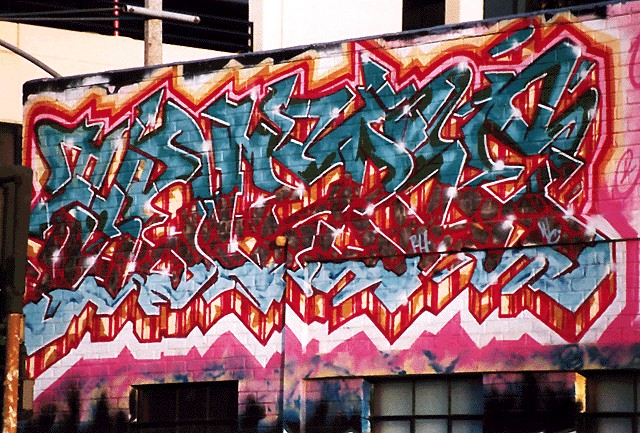
  • Graffiti Expression To You - Global developments

    South America

    There is a significant graffiti tradition in South America, especially in Brazil. Within Brazil, São Paulo is generally considered to
     be the current centre of inspiration for many graffiti artists worldwide.[24]
    Artful graffiti in Olinda, Brazil
    Brazil "boasts a unique and particularly rich graffiti scene ... [earning] it an international reputation as the place to go for artistic inspiration."[25] Graffiti "flourishes in every conceivable space in Brazil's cities."[25] Artistic parallels "are often drawn between the energy of São Paulo today and 1970s New York."[26] The "sprawling metropolis,"[26] of São Paulo has "become the new shrine to graffiti;"[26] Manco alludes to "poverty and unemployment ... [and] the epic struggles and conditions of the country's marginalised peoples,"[27] and to "Brazil's chronic poverty,"[28] as the main engines that "have fuelled a vibrant graffiti culture."[28] In world terms, Brazil has "one of the most uneven distributions of income. Laws and taxes change frequently."[27] Such factors, Manco argues, contribute to a very fluid society, riven with those economic divisions and social tensions that underpin and feed the "folkloric vandalism and an urban sport for the disenfranchised,"[28] that is South American graffiti art.
    Prominent Brazilian graffiti artists include Os Gêmeos, Boleta, Nunca, Nina, Speto, Tikka and T.Freak.[29] Their artistic success and involvement in commercial design ventures[30] has highlighted divisions within the Brazilian graffiti community between adherents of the cruder transgressive form of pichação and the more conventionally artistic values of the practitioners of grafite.[31]

    Middle East

    Graffiti in TehranIran.
    Graffiti in the Middle East is slowly emerging, with pockets of taggers operating in the various 'Emirates' of the United Arab Emirates, in Israel, and in Iran. The major Iranian newspaper Hamshahri has published two articles on illegal writers in the city with photo coverage of Iranian artist A1one's works on Tehran walls. Tokyo-based design magazine PingMag has interviewed A1one and featured photos of his work.[32] The Israeli West Bank barrier has become a site for graffiti, reminiscent in this sense of the Berlin Wall. Many graffiti artists in Israel come from other places around the globe, such as JUIF, from Los Angeles, and DEVIONE from London. The religious reference "נ נח נחמ נחמן מאומן" ("Na Nach Nachma Nachman Meuman") is commonly seen graffitied around Israel.

    Source  http://en.wikipedia.org/wiki/Graffiti   


    (c) Copyright 2010 Art Expression. All rights reserved
    .